Thursday, October 21, 2010

Top 10 Qualities of a Great Patient

After listing my, “Top 10 Qualities of a Great Physician”, I couldn’t help but follow up with this list. After almost twenty years of medical visits and hospital visits with a child with complex medical issues, I certainly can’t speak for any physicians, since they would be a better source of what makes a really good patient, however I will share with you my rules on interacting with physicians. As Dear Son’s mother, advocate and caregiver, I’ve developed some systems and some rules that I try to follow to make things go smoother.

1.) Be on time. If you have an appointment, make sure to allow enough time to get to your appointment on time. I try to add in the travel time, parking time, time to get Dear Son’s wheelchair out of the car and get him out of the car plus time to get him ready, myself ready and a little extra time for the last minute emergencies. For Dear Son, an appointment is usually four hours out, meaning I have to start his food four hours in advance of an appointment for him to finish on time (he’s on gtube feedings), plus time to change him, get his medications, etc. No one likes to rush and I don’t like to rush Dear Son. It’s much nicer to take your time and make it a good day. Also, Big Academic Medical Center has limited parking so parking alone can add fifteen to twenty minutes to a visit unless you valet park, however there are long wait times for that as well.

A good rule of thumb is that when you are getting ready, plan for the worst case scenario. Bring lunch or medications for your child so if the physician is running behind, your kids aren’t hungry. I would often pack Dear Son’s lunch and medications and then I could give it to him in the cafeteria of the medical center or in the waiting room if needed since medications can’t always wait. It’s always nicer to have everything with you so your kids don’t have to be hungry and wait until you get home, especially if they can’t eat anything by mouth and rely on tube feedings.

For diaper changes, bring everything you need, including a plastic bag to tie up the diaper. No one wants to smell a dirty diaper in the examining room.

2) Bring a List of Medications/Supplements That You Are Taking. I keep an emergency information sheet for Dear Son that lists all his medications, the name, the strength, the dose, etc. I have this typed up and keep it on hand at all times. For myself, I don’t take any medications but do take some vitamin supplements. Naturally, my list is much shorter. Take the time to make a formal list, and type it up in Microsoft Excel or on your pc if you can, so it’s easier to read. Your visit will go a little faster if you have that information. This saves time since they can just make a copy for their file and you don’t have to sit there and try to remember the name of the prescription, the strength and the dose, especially if the patient is on multiple medications. You should also know the reason that medication was prescribed and by whom.

With regards to electronic medical records, I realize that sometimes this information has already been entered into the system, however that doesn’t mean it’s accurate. Always ask to check the information to make sure it’s accurate.

And finally, in addition to a list of medications/supplements, you need to bring your insurance card to the visit.

3) Write Out Your Questions /Concerns in Advance. I get ready for the visit weeks in advance. I have the date in my calendar and as I think of questions, I simply jot a note in my weekly planner of things to discuss on the visit. Then, when it’s time for the actual visit, I have my questions all ready. The night prior to the visit, I take out my medical notebook, write the date, physician name and time and then write a bulleted list with my questions. This is also a great time to see if you need any prescriptions for any medications you are on. It’s much easier to write them up in an office visit than calling the office and having them call it in. Having your list of questions, saves you time and saves them time. Be respectful of their time. They have a lot of patients to see.

4) Keep it Brief and Professional. View your visit as a business meeting and less as a social visit. Be polite and be professional. Stick to your questions. This isn’t the time to share family photos or to give them all kinds of information. And this should go without saying but always remember that your physician is just that, he or she is your physician. As a result, share only information that is needed for the visit and leave the personal information out. They’ll respect you more if you don’t waste their time.

5) Give Good Information. This can be hard at times. As you prepare for your visit, try to be a little more specific with regards to your symptoms and concerns. For example, let’s say Dear Son is having seizures. Typically, I’ll notice that he’s having more issues or crying out more than normal. I know it’s different however I really need to give the doctor more information than that. Things that will be helpful will be noting the frequency, duration, type and what exactly Dear Son is doing during the seizure. It can be helpful to track them for a few days.

So let’s see how good information would translate in the office visit. Dear Son began having more seizures a while back. I knew he was having more of them however when I started paying attention and tracking them, I noticed that the bulk of them occurred between 1:30-3 p.m. in the afternoon. I also knew that Dear Son received most of his medications in the morning and evening and very little around noon so was most likely crashing. In this case, I called the office in advance, explained the situation and asked if the physician wanted drug levels of the medication. He did. When we arrived at the office visit, I could give him the information in more detail and he could look at the drug levels. As a result, even though his medications were in range, he increased the noon medication. Had I not called in advance, it would still have been fine. He would have just ordered the lab test at the office visit and then would have made the change once he got the information.

A second example might be if you were having back pain. If you have back pain, you’ll want to note the location of your pain (is it down your leg or lower back or where), the type of pain (is it sharp, is it throbbing or is there numbness), and does it go away with medication or rest? Is it worse at any particular time of the day? For pain, you also want to include the intensity of the pain. On a scale of 1 to 10, is your pain a 5, a 7 or a 10? Is it a 10 every day, five hours of the day or what?

For children who are non-verbal, pay attention to their facial expressions. As their mother, you know when pain is not normal and what face represents severe pain. Last November, when Dear Son was released from the hospital, he had severe pain and was screaming for weeks. I kept calling the doctor and he’d make a change, or admit him or add a medication or whatever. Dear Son kept crying. At one point, they thought that he might just cry all the time now. I said no, that Dear Son is in severe pain and that is not like him. I stuck to my guns and it paid off. On the second admission in January, they were able to locate the source of the pain. Be persistent when you know you are right. It’s less about being right but more about taking care of your children so they don’t hurt. Remember, you know your child better than anyone else. The doctors want to find answers as much as you do.

Next, think about the problem and how it affects your daily activities? This is huge. If you have an issue that is affecting your work or home life, meaning you can concentrate or do your work because the pain is so severe, you need to get it addressed. These are examples of the types of information that is helpful for the physician to make a good diagnosis.

And finally, don’t forget to mention any major changes in your life. If the symptoms presented themselves after someone died, or if you’ve have a divorce, job change or any other major life changes, whether positive or negative, you need to mention it. Stress can also affect us and that information would be valuable.
I should also note that if things have changed significantly and you’ll need more time to discuss these issues, you may need to call the doctor’s office in advance, to ask for a longer visit time. Some office visits are scheduled every ten minutes, every fifteen minutes or every forty five minutes. It varies depending on the specialty of the physician and type of visit. First visits are often given longer times. That doesn’t mean you need to take x amount of minutes, just address your questions and move on.

6.) The Internet-I thought it would be important to address the internet here. Many people read a lot of medical or health information on the internet. As you know, not all of it is true however it’s hard to know what to believe sometimes when you don’t have the knowledge base of a physician. From a physician’s standpoint, it can be hard to keep abreast of all of the information out there as well. However prior to an office visit, if there is something that has peaked my interest online, I’ll try to research it a bit more on PubMed and then if it still holds water, ask the physician. What I recommend is that if you have a question, bring a copy of the information with you and ask the physician. Please note, they do not have the time to sort through pages and pages of information you have gathered from the internet. Pick and choose what is important to you and ask them.

7.) Follow instructions.-Once the physician has mapped out a treatment plan, follow it. Take the medication as directed and/or follow up with anything else they have given you. For example, if they have prescribed nebulizer treatments two times a day or whatever, follow through. When you have patients with chronic and complex health conditions, like Dear Son, the physicians will have a lot more respect for you if you take good care of the patient and follow directions.

8.) Use Paging Wisely and Only When Necessary. Physicians are busy people and I try to respect that by paging them only when necessary. My rule of thumb is this…if it’s something the nurse can handle, I’ll call the office and speak with her during normal business hours and if I have a concern for Dear Son, that I think the doctor needs to address immediately, I might call and speak with the doctor. A good rule of thumb is this, if I have to think about whether or not to call the doctor, it probably isn’t an emergency. If I know I have to call the doctor, then it’s probably valid. It’s kind of like calling the fire department. You don’t always have to call them if you smell smoke, however if you have a fire, it’s time to call.

If I have an emergency, I’ll page the doctor and get instructions on what I need to do. For example, if Dear Son is having multiple seizures that are escalating, I’ll page the neurologist and ask him how to proceed. He may ask that I take him to the ER for an admission or he’ll tell me how to treat him at home. I try never to abuse this privilege and I feel it is just that. This goes back to the reason above about being professional. I don’t ever want to be in an emergency situation where the doctor doesn’t take my call because he thinks it isn’t valid or that I am just calling him unnecessarily. Physicians have lives and families too. While it’s true they may have dedicated their lives to helping others, that doesn’t mean that anything goes and they need to be available 24/7.

9.) Medical Errors/Mistakes.-There may come a time when things don’t go as well as you expected or don't go well at all. In these situations, I try to address them privately. In the case I mentioned the other day, where I had issues with the attending specialty doc not visiting in the ICU, I addressed it at an office visit, a few months later. Some things need to be addressed immediately. The bottom line is that I try to treat people as I’d like to be treated and give them an opportunity to respond. Overall, I think I have pretty good relationships with all of his physicians and I can’t think of any time where I’ve had any issues with his primary physicians.

10.) Say Thank You. Physicians give up a lot of time to do their jobs and to take good care of you and your family often at the expense of their family. When they go above and beyond the call of duty, be sure to thank them. Everyone likes to be appreciated and it’s nice when you notice. Just don’t overdo it. You don’t need to send a thank you after every hospitalization, just use good judgment.

In summary, when you have a child with complex medical issues, it can be a lot to deal with over twenty some years. On the flip side, I never keep a physician that I don't like. If I don't personally like a physician, for whatever reason, I'll simply find another doc. There are so many good physicians, who are smart, kind and likeable, that there really isn't any reason to settle for less. And for me, if I have to be in contact with someone for long periods of time, as in the case of Dear Son, I want to make sure it's a person that I like and respect and someone that I feel comfortable addressing any concerns or questions that I may have. I've been very fortunate over the past twenty some years to have a nice group of physicians who have taken great care of Dear Son and myself, so I try to take the time to return the favor.

Tuesday, October 19, 2010

Top 10 Qualities of a Great Physician...A Mother's Perspective


It’s no secret that I spend a lot of time in hospitals. Dear Son has endured some sixty plus hospitalizations and I’ve been there for every one. Over 90% of these hospitalizations have been at a teaching hospital or major academic medical center so I’ve encountered physicians at all stages of their careers. I’ve met residents, fellows and attendings and what is most interesting is that the standout physicians are standouts from the beginning. So let’s imagine for a minute that I am sitting in a patient room at a hospital with Dear Son. Here are my thoughts on what makes a great physician from a mother/caregiver’s perspective.

1) They are always prepared. Much of the work is done before the physician even steps through the hospital door. Good doctors will know three things: the patient’s name and baseline, diagnosis/medical history and finally, what brought him into the hospital this admission. Most attendings do this however many residents don’t.

In a good situation, a doctor will know that Dear Son has a history of seizures from birth, is severely developmentally delayed, is non-verbal, non-ambulatory, on a feeding tube, can’t clear his airways with the risks being seizures, aspiration and respiratory depression and what brought him in this admission.

Residents who are unprepared, rush in the room, don’t read the patient’s medical history, then ask if his appetite is poor now that he’s sick or if he’s weaker than normal and not walking as much. They’ll want a quick update as to how he’s doing so they can update the attending. Their goal is to get the information as soon as possible. They often won’t identify themselves so I am at a loss to know what speciality they are from (Peds, Neurology, GI, etc.) which would help me better frame my answers. I can tell by their questions, asking me if he eating less by mouth, that they’ve never even read the medical history since Dear Son eats nothing by mouth and eats via a gtube. When it’s that obvious, I’ll ask that they take a minute to read the history and then come back and I’ll be glad to answer their questions. Of course, it’s not just one resident that comes in the room, but multiple residents, from multiple shifts, from multiple specialities, and that can all be in just one day.

Being prepared is about respect. I would never dream of walking into a client’s office and meeting with a CIO or anyone in the organization without having done my homework. I would know who they were, the history, their history with my company, customer support issues and as much as I could, as well as reading through their entire contracts so I would not be surprised by anything. Translated, it means being prepared. Now I do understand time constraints in a hospital setting, however if you are involved in the decision making process with patients, you have to take a minute or two to get the basics which include the baseline, medical history and the purpose of the admission. I think residents forget that patients are their clients. Residents shouldn’t demand respect, they should command respect by their actions. Being prepared commands respect.

For Attending Physicians, I most often see this step omitted in new patient histories. For example, sometimes if I make a visit for Dear Son with a new physician, the office will send out a packet to be filled out with the patient’s medical history. It might take three hours or so for me to complete this packet of information and the physician will not even look at it prior to seeing Dear Son. If you ask for information, then read it prior to the office visit, even if it’s five minutes prior to walking in the room. I don’t want to spend three hours assembling information for you and then repeat every detail once I am in the office. If you want to discuss it in the office visit, then don’t send out the packet. My time is important too. I don’t have time to do this twice and I don’t want to spend two hours at an office visit.

2) They always introduce themselves. When meeting someone for the first time, we all value a proper introduction. It’s good to know the other person’s name, their title and a little bit about them. When a person walks into the hospital room, I want to know three things: who they are, their specialty, the purpose for their visit.

A great introduction goes like this: The Fellow walks into the room, standing tall and appears calm and not rushed. He smiles, says hello and asks if it’s Dear Son, introduces himself by saying his name and specialty, then shakes my hand. He asks for my name. He then says a sentence or two letting me know he’s read the patient history, then asks me how he’s doing and asks for information.

A poor introduction goes like this: Resident rushes into the room and wants a quickie update. They look frazzled, are hurried and demand answers, regardless of what you are doing. They ask questions that indicate they haven’t read any patient history and when you ask them if they’ve read it, they get annoyed and still ask the same questions. They waste your time and theirs. The reason a poor introduction is bad is not only because it sets things off on the wrong foot but because it does not allow them to get good information about the patient to make good decisions. If I don’t know who you are, or your specialty, I can’t answer questions well. The worse introductions in my experience are always “pediatric” specialities. They rarely introduce themselves, rarely read the medical history, always appear hurried/rushed and do a lot of unnecessary work. More often than not, they don’t spend their time wisely. This is just my experience at this hospital and certainly does not cover all residents.

The best introductions in my experience over the last twenty years are pediatric neurology fellows. They are smart, cool, calm and collected. They have great manners, are very bright and when you talk to them about their specialty, they just glow.

3) They are good listeners. Having read the medical history, good doctors ask good questions and listen to what is said and what is not said. They read between the lines. They know what information is important to the decision making process and what information is important in caring for the person. A good doctor knows both.

4) They look you in the eyes. I probably wouldn’t mention this had it not been for the electronic records. Electronic records are just that, electronic. Take the time to look at the patient when you are speaking to them. I had one visit where the entire time the Attending Doctor sat with his back to me as he asked the questions, entered the information into the pc, then edited the information in the pc, then re-edited it again. If you want to have a conversation, have a conversation. If I have a situation that is uncomfortable for me to ask you about, I’ll never ask that with your back to me. And that may be the one piece of information you need to make the right diagnosis.

5) They treat everyone well/equally. This is a symbol of class and but something that is so closely aligned with being a great doctor, that I had to mention it. Great doctors are liked by everyone, not just the patient’s, the patient’s mother or by the caregivers. They treat everyone well and I’ll always hear the hospital workers sing their praises as they are cleaning the room or doing whatever task is at hand. When a physician is really good, I’ll hear that from every level of the hospital staff.

6) They allow enough time to address your concerns. The best example of what to do is by talking about what not to do. A poor Attending will come into the patient’s room, say hello, ask how the patient’s doing, get a page, take the page, then say the visit is done and go take the page. I haven’t had a moment to ask any questions and I’ve waited all day to see them. The bill comes in the mail with a charge of $765.00 for that visit.

7) They are good communicators. Good doctors communicate well. They tell you not only what they know, and what to do but what to watch for or what you should be concerned about. In communicating well, they help define the parameters around knowing when it’s an emergency or when to seek medical care. That saves their time and mine.

8) They are kind. There is something about kindness that shows through. You can make a right decision or you can make a right decision for that patient. If you get lucky, they are the same.

9) They always take time to see you when you are in the hospital. This is huge. After all, when you are the sickest, isn’t that the time when you want to see the doctor the most? A good doctor doesn’t always have the time but he always makes the time. That’s the difference. Dear Son has been in the hospital a lot. His medical condition is complex and he’s been in many life threatening situations over the past few years. We’ve spent a lot of time in the ICU, he’s been on ventilators a few times, he’s had a transfusion and we’ve had a few admissions where they didn’t know what was going on. As a result, we’ve had a lot of different physicians that have cared for Dear Son. In times of crisis, it can be challenging as a mother when you hear different physicians talk about what they should do for Dear Son and sometimes I’ll admit that I am not sure who to trust so to speak. It always puts me at ease though when his physician walks in because I know that he knows Dear Son the best and because I know that he’s overseeing or working with the physicians with regards to Dear Son. Sometimes, when you are in a medical crisis, it helps to have a physician that knows the patient very well involved in order to overcome the medical crisis. We have been very fortunate to have a doctor who always makes the time to see us.

On the flip side, we had an incident last year with an attending physician who also happened to be the department head. This particular physician had only seen Dear Son once in the hospital and had let the fellows/residents see him. In this case, Dear Son was seriously ill and it was life threatening. I had many questions and this particular specialty was new to me so I didn’t have much experience in terms of what to expect. It was a stressful time for me. During this time, there was a week where this doctor had never come into see Dear Son or talk to me. At the follow up office visit, I sat down with the doc to address this. I explained the situation in the hospital and said that I would need them to come by more often in the hospital settings since I would have questions and that I would need them to come by more often than once a week. I explained that this was a new specialty to me and that I would have questions and would want to get answers from them versus getting these answers from fellows or residents that did not have their experience. The Attending Physician became very angry and then read me out for about five minutes telling me that they were every busy with clinic and all of the demands and that they didn’t have time to do this. I remained calm and said that was fine, but if that Dear Son didn’t fit into their practice, I would have to find another doctor. I explained that I need a physician the most when Dear Son’s in the hospital, not when he’s in clinic so to speak and that if they don’t have time to see us in the hospital, then they weren’t the right physician for us. Notice, I didn’t say they weren’t a good physician but only that they weren’t the right fit for us. After they went on again, they calmed down and the office visit went fine. It’s not always easy to have these conversations but sometimes you have to have them. I always like to give someone an opportunity to respond to an issue before moving on.

Some months later, we had another crisis and I had to page this Attending Doctor. The Attending was leaving on vacation on a road trip within the hour and couldn’t have been nicer. They addressed the crisis, mapped out a plan, saw us in the hospital and did a great job at our follow up visit. Addressing the situation in clinic made all of the difference. I also made sure to thank them at our follow up visit.

10) They admit it when they make a mistake. This is also important. Everyone makes mistakes and physicians are no exception. It’s o.k. to acknowledge a mistake, apologize and move on. It’s not o.k. to ignore it. Ignoring it sends the message that they don’t care, it wasn’t their fault and the patient isn’t important.

For example, I had a situation where a well liked and well known physician made a medical error that nearly caused Dear Son’s death. It was more than likely a bad judgment call but how they handled the situation was more than disappointing, it was enraging. The mistake occurred and Dear Son nearly died. The doctor came to see Dear Son after the ICU docs and docs involved in Dear Son’s care strongly urged him to see Dear Son. He walked in the room and said Dear Son wasn’t as bad as they said. He got a page, left the room and never said a word. He charged me for the visit. During the hospitalization which lasted several weeks, he refused to see Dear Son. He never came by. I asked to see him now that Dear Son had transitioned to a regular floor and off the ICU floor. He refused to stop by. I spoke with the Peds Attending, whom I knew from the other hospitalizations and explained the situation privately to him and asked him if he could help arrange a visit. The doctor still never showed. We tried to see him for a follow up office visit (while we were still in the hospital) and he still refused to see us.

In the meantime, I went online while I was in the hospital with Dear Son and researched the largest medical malpractice firm in our state. They had only lost one case in their career. I was prepared to call them when I left the hospital. Finally, the Attending Doctor arrived and said he heard that I wanted to speak with him. I explained in very terse terms that I had some concerns I had around the surgical procedure and the fact that I made multiple attempts to see him however his behavior was unacceptable and that I didn’t appreciate that behavior. I said that I wasn’t going to beg to see him and that if he didn’t want to take the time to talk to me that we could talk through our attorneys. It got his attention, he sat down and answered all of my questions. I won’t go into detail however this entire situation could have been avoided had he simply spent five minutes with me in the hospital room in the ICU. I went above and beyond the call of duty to attempt to meet with this physician to discuss this situation and I’ll never do that again. In the future, if they don’t want to meet, I’ll just proceed as I need to. I can accept a bad decision; I can’t accept it when they ignore me. This issue came many years after a previous medical error by a surgical nurse caused over $500,000 in multiple hospitalizations and my son never walked again. Medical errors are serious business.

In summary, I’ve learned a lot about physicians over the years. We’ve been fortunate to have some wonderful physicians that take excellent care of Dear Son. Our Pediatrician did a wonderful job for many years taking care of Dear Son. Our Pediatric Neurologist has done a wonderful job over the past twenty years in caring for Dear Son. I often am at a loss to know how he manages to give such exemplary service over such a long period of time. In the end, it’s not a hospital that makes a facility great, it’s the doctors that make a hospital great. And when you or a loved one are sick, the person you want to see the most will always be “your” doctor, not another Attending, not another Resident, not a Hospitalist or anyone else.

Note: Dear Son is eighteen years old and suffers from seizures, dystonia and severe developmental delay as a result of a random mutation of the ARX gene. He also has a progressive neurological disorder and is in the later stages of the disease.

Thursday, October 07, 2010

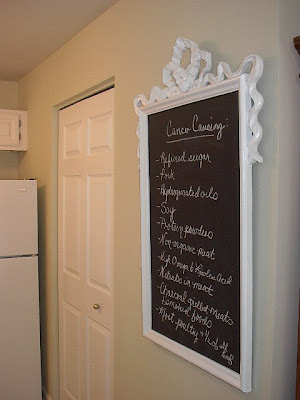
Romantic Kitchen Chalkboard Makeover!

After seeing all of the chalkboard makeover projects, I couldn't resist doing one myself. I am not a typical crafty type person however after thinking about it, I decided that a chalkboard would be perfect in my kitchen. I recently started a little kitchen makeover project on my apartment kitchen (I'll show before and afters in a few weeks when I'm done!) and tried to work with what I had on hand. I prefer traditional, classic style interiors with preferably, a little Louis XV thrown in. I decided to use this gold decorative mirror for my new chalkboard. (Don't worry, I have plenty of mirrors.) Here is a before picture from my former apartment. Apparently, that's one of the few pictures I have of it. Ignore the crooked candle in the photo...sheesh!
I started by taking the back off of the mirror. This little guy was sitting between the drapery panels and looked pretty cute. Of course, when I tried to take his picture, he ran over to stand on top of the mirror. Notice his cute little legs or paws rather. He doesn't really have much for legs. And yes, he's full grown.

Originally, I was going to put chalkboard paint over the mirror, after priming it of course, however when I saw the back of the mirror, I decided I could use that instead.
Also, when I tire of the chalkboard, I can flip it over and still have my mirror. Brilliant. All I needed to do was to remove the glue from the back of the mirror with some liquid adhesive remover like Goo Gone. Once that was done, I could begin painting the back of the mirror. I used Rustoleum Chalkboard paint and brushed it on with a foam roller. Just follow the directions on the can. Also, I tried to make sure that once the paint was on that I went over it again with long strokes in a "W" type pattern so there weren't any roller marks from stopping and starting the paint roller. I let it dry well between coats. I did two full coats.
The frame is another story. I contemplated leaving it gold until I got my new Breville Smart Oven in stainless steel. Then I decided it had to be white since the gold and silver weren't going to work very well. Initially I thought I could just spray paint the frame however for some reason, it just didn't look right. I did a million light coats but it wasn't covering well. I ended up re-priming it with more white paint and painting it some more however the white seemed more like a blue white than a white-white. Finally, I painted the entire mirror with a foam brush using the wall/trim white paint I used on the kitchen moldings. I did two full coats. Here is a picture of the finished chalkboard. All I need to do is to screw the chalkboard to the frame.

Here is is on the wall.


Another picture...


And finally, after three days of letting the chalkboard paint cure, it's ready to write on. My older sister died of colon cancer last year. She was in her fifties. Maybe the cancer causing foods isn't too cheery for the kitchen, lol.

How about the lunch menu instead? That's the beauty of the chalkboard. Will we ever get tired of these? Actually, the chalkboard isn't quite accurate...I am trying a new recipe today-Cheese and Spinach Calzones. I made my own dough and will be baking them in my new Breville Smart Oven, which is a combination toaster/convection oven compliments of my younger sister. I just love it. As for the calzones, Dad's stopping by for lunch so I am thinking he'll want some Italian sausage in his.
I hope you enjoyed my new kitchen chalkboard. I'd love to hear from you if you do. Do you have a kitchen chalkboard or are you thinking of making one? I am linking this project to Cindy's Show and Tell Day at My Romantic Home and to Chris at Just a Girl's Show and Share Day. You can check out more great projects there.

Friday, October 01, 2010

Pure Joy!

Dear Son went back to school today. He has not been to school in almost a month. As usual, when he is excited, he is wide awake most of the night. Last night was no different. He was making noise at 3 a.m. and I got up to make sure he was o.k. He was wide awake and all bright eyed. I told him it was too early to get up for school and kissed him and went back to bed. I started his gtube feeding at 3:55 a.m. and he was awake. He got on the school bus at 7:30 a.m. this morning and the bus driver was talking to me so he invited me to come on the school bus. When I came on the bus, they were tieing down his wheelchair. Dear Son was grinning ear to ear and the look on his face was pure joy! He was so happy to be going to school! It was just awesome to see him so excited. I haven't seen him this excited in weeks. Somehow, you just know it's going to be a great day.

Tuesday, September 28, 2010

Back to School...

Dear Son is doing much better. He was able to come off the oxygen this weekend and seems to be doing rather well. He is happy and is not coughing. Unfortunately, there are a few teachers and students out at school with cold/flu like symptoms. As a result, he will not be going to school tomorrow because I don't want to risk him getting sick again.
We have an appointment with the pulmonary doctor early next month. I spoke with our neurologists office today (he functions as Dear Son's primary) to get some direction and parameters with regards to school. On the one hand, I have no objection to keeping him home during the pneumonia season and I was concerned about sending him back to school with people being out. As you may recall, Ped Neuro Doc suggested keeping him home if people had any symptoms. I explained that our appointment with pulmonary was next month and asked if I should keep him out of school until then or how should I proceed. The Neuro Nurse suggested I send Dear Son for two half days a week (previously he was going three) to see how he handles it and do this until our pulmonary appointment next month. Dear Son's first day back to school will be Friday. I am a bit nervous about this-Dear Son is doing well but I don't want him to get sick again. I had instructions from the pulmonary attending to continue nebulizer treatments twice a day until his October appointment so that should help.
Regarding seizures, Ped Neuro Doc added a small amount of Valproic Acid back since his platelets came up. This worked beautifully for Dear Son since it stopped the writhing and constant tremors.
Also, while he is off of the oxygen for now, Ped Neuro Nurse suggested keeping some portable oxygen on hand as a life saving measure. I'll do that but at least the large oxygen concentrator and the large back up pump can be returned. I don't have room for all of that stuff.
On Saturday night, Dad took Dear Son for two nights. He wasn't comfortable taking him once he got out of the hospital so I kept him last weekend. On Sunday, I painted my kitchen. I washed the walls, sanded, spackled, washed and rinsed and painted two coats. I needed to get it done on Sunday since Dear Son wasn't home and because I had to work on Monday. It's a small kitchen so it took longer to move out the refrigerator and stove so I could paint behind them. I had to move them out one at a time since the kitchen was so small and then it seemed like forever waiting for the paint to dry so I could move them back. Some people suggested not painting behind the refrigerator and stove since I have to repaint it back when I move, but it would drive me nuts to pull out the refrigerator every month to sweep there and see that wall half painted. That's just not my style. It turned out nice. I have a few things to finish up and then I'll show some pictures. I am making a chalkboard out of a mirror that I had and I have a faucet to install. I haven't looked at any lighting yet or hardware. As for painting, I have two small areas to finish up but I needed Dad to remove the bifold door so I could paint the inside of the opening and then I needed to borrow a ladder to reach the area over the top of the cabinets. I live in an apartment so I was limited with what I could do so it's merely a small cosmetic update.

Wednesday, September 22, 2010

One Step Back...

Things seemed to be going better last night. He slept after coming home from the blood test and the terrible seizures he was having on Sunday and Monday night, seemed better. He was on 1/2 liter of oxygen yesterday and I removed it last night because Dear Son had pulled it off and didn't seem to want it anymore. His oxygen saturations were great yesterday and last night. They were fine this morning as well and I also checked them repeatedly throughout the day.
Late this afternoon, he started having some seizures during his nap. At one point, he yelled out pretty loud. I went in to check him and he was sound asleep. By around 7 p.m. or so they started to cluster and have been clustering for the last two hours. I repeatedly used the VNS and also sang to him; for some reason that seems to help relax him a bit even if only momentarily. I checked his oxygen and it had started to fall and was down to 88 so I added a liter of oxygen around 7 p.m. hoping to boost him up. Instead, it's been two hours and his oxygen hasn't improved so I increased it and will watch him. I am not sure why it's dropped since he seems o.k. other than all the seizures. I want his oxygen saturation to increase and stabalize before I reduce the oxygen. Sometimes he needs more oxygen at night but like I said previously, he had been doing fairly well. I am not sure if these seizures are causing some issues for him.
Hopefully, we'll hear back from the doctor tomorrow after he gets the lab work. If not, I'll have to touch base with him to see what else we can do. In the meantime, I gave one of his midnight seizure meds a bit early to see if I can stop these seizures before they get out of hand.

Tuesday, September 21, 2010

Whew-It's a lot of work!

Not sure what else I can say about the last few days other than whew! Dear Son seems to be recovering well. Of all of the pneumonias in the last few years, this one seems the most mild, at least in terms of his recovery. I think the oxygen is helping out a lot since he's not working so hard after being released from the hospital.


He still is having some issues with seizures. They removed one of the seizure meds since they thought it was causing his platelets to drop however he's having some issues. At times, he has some terrible writhing type movements-looks very much like Michael J. Fox at times moving all over. His head moves so much it's hard to keep the nasal cannula on. He had some horrible cluster type seizures Sunday evening and again on Monday evening but seems better tonight. I spoke with his neurologist yesterday and he had me add one pill of his other seizure medicine to help Dear Son out. Today, we took him over to another hospital for a blood test.


I've been pretty tired keeping up with this new schedule. I am doing nebulizer treatments and chest pt four times a day, along with leg and feet massages for edema and doing his hand splint therapy to keep his wrists in alignment. All of this on top of meds every six hours, plus feeding, diaper changes, positioning changes, general grooming and moving him back and forth from the living room to the bedroom have me bushed! I don't think I sat down for a few hours between all of this.

I also have medical paperwork to do. I completed the paperwork for a Guardianship for him the week prior to his hospitalization and once the doctor returns the form, I can go to the courthouse for a date. It is recommended that a parent seek a guardianship for a person once they turn 18 so they can continue to make medical and financial decisions for them. I think this past year or so has really taken it's toll on me a bit. The lack of sleep really makes it more challenging to do all of these tasks. I typically get two to four days a month of uninterrupted sleep when his Dad takes him for the night and I am always amazed at how much better I feel and how much more I can get done on a full nights sleep.


Dear Son looks good, other than when he's having seizures or moving with all of the writhing type movements. One thing that seems better than previous pneumonias is all of the secretions. He doesn't seem to have any really. The antibiotic seems to be working so I am thankful for that.

Update: I just received a call from Dear Son's personal nurse at school. She inquired about him and offered to do any necessary treatments he needed. I hadn't thought about that option actually but she volunteered to do nebulizer treatments, oxygen, etc. I took Dear Son off his oxygen last night since he had pulled it off and his oxygen saturation was fine. He was on 1/2 liter all day yesterday. I think having school do a chest pt and nebulizer treatment would be great. I also talked to them about doing his splint therapy (these are arm splints to keep his wrists in a neutral position); the optimum schedule is three times a day and I suggested having him wear his splints to and from school. Each way is a 30 minute trip and that way, I'd only have to do one more treatment at home, at least on school days. I'll talk to the doctor's office on Friday about him returning to school next week. If it's a go, I think it will be great to have some assistance. To help out, I'll probably create a checklist to make things easier.

Friday, September 17, 2010

Home

It's been a heck of a long week but things are now going much better. I think what made this incident more stressful on Monday was that it happened so fast-I basically got out of bed in the throws of an emergency. Second, due to his past respiratory history, I was a bit jumpy fearing the worst-that he'd get pneumonia and die.
Once Dear Son was admitted to Big Academic Medical Center, things went much better. It makes a huge difference when the ICU knows his history and knows exactly what to do. They had him on the right amount of oxygen and he started to look better. The Local Hospital wasn't giving him enough oxygen to help him recover. By the end of the day on Tuesday, he was much improved due to the oxygen support. He stayed at 4 liters for a while and then they were able to drop him a bit as the week progressed.
Overall, we had two main issues this week. The chest xray confirmed a right lung lower lobe pneumonia and also showed a fairly hazy left lung. The Pulmonary Attending, who had never seen Dear Son previously, wasn't quite sure what to make of the pneumonia however after learning his history, thinks Dear Son aspirated his secretions. As a result, they treated him with Clindamycin, a broad spectrum antibiotic, if I recall. They started it on Tuesday and on Wednesday, he seemed to be feeling much better and looked more like his old self. Fortunately, we were able to catch this pneumonia very early. Another day or so, it would be hard to tell what we might have seen.
The second issue we had this week was low platelets. Low platelets could be related to the infection or to medication. In Dear Son's case, he actually had low platelets back in May, when a blood test confirmed them prior to his Make a Wish trip. Dear Son had some bruising on his legs and then it was learned that his platelets were low. This time, the Neurology Attending thought Dear Son's Valproic Acid might be the cause so they discontinued it. The platelets went up the next day and then remained the same today. I must admit I was a little worried when the removed the Valproic Acid in terms of seizure control. They wanted to remove it but didn't increase any of the other medications nor did they change the VNS. Dear Son did have multiple small seizures, multiple times throughout the day however I was able to control most of them with the VNS and we didn't have to use any Ativan at the hospital. My concern however is that once Dear Son starts moving around, he'll have more. I planned on asking Ped Neuro Doc today however he just returned from vacation today and didn't stop by. I had hoped to have a back up plan so I wouldn't have to page anyone this weekend. At this point, we'll just wait and see and hope for the best.
The problem with low platelets is that it can cause bleeding. It was explained to me that when your platelets are less than 20, you can experience spontaneous bleeding. While Dear Son's platelets are still under 100, they felt it was safe. The other issue with low platelets had to do with the Valproic Acid. Typically, if the Valproic Acid levels reach a certain number, they'll see low platelets. In Dear Son's case, his seizure meds, including his Valproic Acid, were in the therapeutic range and should not have caused an issue with low platelets.
Dear Son remains on a small amount of oxygen, currently one liter. The Pulmonary Attending thought it would be better to send Dear Son home on some oxygen so he wouldn't have to stay at the hospital while he is weaned off. He should be off the oxygen in another few days or so. We left the hospital around 7:15 tonight and by the time we went to the pharmacy and got home, it was late. The homecare company came here around 11:30 p.m. to set up the oxygen. They delivered a portable tank at the hospital so we could get him home. The plan is to continue oxygen, along with chest PT four times a day, nebulizer four times a day and to continue the antibiotic as well. It has a ten day course and we just finished day 4. I can't say that I was thrilled to get oxygen at home however I am glad to have some support for him. I think at this point and time, it's good to have a back up plan and at least if I have some oxygen at home, he can take his time getting better.
Overall, it was a good hospitalization. Dear Son wasn't horribly sick like previous hospitalizations. In addition, the staff was wonderful at all levels, in the PICU and on the main floor. There seems to have been some nursing changes and I must say it was the highest level of service I think I've seen in years.
In addition, a few of the physicians commented on Dear Son and what a good job I've been doing. The Pulmonary Attending told me today that she was amazed at how good he looked. She said she couldn't believe he was 18 and didn't have any pressure sores at all (When patients get older and get larger, it is much harder physically for caregivers to move them around and reposition them since they weigh more.). She said that his skin was remarkable and that the only way he could look that good is if I reposition him all the time to prevent pressure sores, which I do. Dear Son has a tiny pressure sore on his right ear where his ear crimps when he lies on his side. I told her about that and she said she had looked at that earlier in the week and said it was nothing. Overall, it was nice to hear such glowing remarks.
In addition the Pediatric Neurology Fellow was talking to me about Dear Son. He said he was amazed that Dear Son didn't have any contractures. Contractures are very painful and can result from a lack of good care. He couldn't believe as large as Dear Son was and as old as he was that he didn't have any. He said he feels bad when he sees kids as young as four or five with them.
Dear Son really seemed happier this week after the oxygen and antibiotic kicked in. He looked at many of the doctors, tried to say hello to a few of them and smiled. I haven't seen him this happy in a while so the extra oxygen must really have helped him.
One thing that was kind of funny happened today. As I have mentioned before, I massage Dear Son's legs and feet with organic, virgin, coconut oil on a daily basis. It's a great massage oil and the massaging keeps the edema (swelling) down. The cardiologist had recommended I massage Dear Son's legs/feet twice a day to help with the swelling (The coconut oil was my idea.). Well, every day I rub his legs and feet and talk to him about how nice it must feel, yada, yada, yada. I would ask him if he likes it and he never responded too much. Well today, I decided to rub his free hand and fingers. He had an IV in the one hand and his free hand was bruised up and bloodied up from the repeated blood draws and I felt kind of bad for him. So I put some coconut oil on his hand and massaged it really good, like they do in the nail salons. He started smiling and laughing and really loved. Here I'd been giving this kid some half hour leg massages every day and he was thrilled with a two minute hand massage. Who knew!
Overall, it's great to be home. I'll have to get his schedule together tomorrow for all of his therapies. The list is getting pretty long lately but I'll do better once I have some sleep in my own bed tonight. The hospital sofa is pretty brutal on my back. I've had horrible pain all week that resolves itself as soon as I sleep on my own mattress.
Thank you for your interest, prayers and support for Dear Son. It is much appreciated.

Tuesday, September 14, 2010

Dear Son Medical Update: Making Progress

It was a very long day yesterday. The day started at around 4:15 a.m. with Dear Son choking and struggling to breathe. The hard part was that normally, if Dear Son has a problem, there is time to do some things to help him, like I did yesterday. Unfortunately, he went downhill so very fast, that I had to call 911 immediately. They took him to Local Hospital however he was a bit out of their league. He oxygen saturation was 85%. He was crying out and struggling to breathe. I asked about a nebulizer and after a while they started one and gave him a breathing treatment for an hour. I had tried to do that at home however he wasn't stable enough and I thought he was going to choke to death.


Once we arrived at the Local Hospital, things didn't improve much. The biggest issue was that Local Hospital doesn't see many of these kinds of patients so they are in over their heads. They didn't seem to know what to do. I had asked to transfer him to Big Academic Medical Center (BAMC) and gave them the numbers to his doctors. The ER Doc said they couldn't transfer him because they didn't have any rooms. One of the issues that also made it challenging was that normally when Dear Son has issues, I page Ped Neuro Doc (who functions as his primary) and he's able to get us a room. He was on vacation and wasn't available. He always takes such good care of Dear Son and I that I admit we are probably a bit spoiled. It was harder having to go through the "regular" channels to get things done. He has a great reputation of taking good care of all of his patients though.


I paged the Head of Pulmonary at BAMC, who is Dear Son's doctor. She was called in last fall to care for Dear Son and I've only seen her once or twice in clinic so I don't know her very well at all. I talked to her at 6:35 a.m. and she said that the ICU had rooms as of Sunday night and that it didn't matter if they had rooms or not, that he needed to be in the ICU at BAMC right away, given his history. If for some reason, they didn't have room after he arrived, they could always transfer him to the other Big Children's Hospital but that he didn't belong at Local Hospital. She was leaving on a road trip in an hour but she said she'd call the other Attending Pulmonary Doc and her Pulmonary Fellow to take care of Dear Son and get his admission started.


Unfortunately, nothing had happened so I made a million more phone calls until things go done. The Pulmonary Fellow had been dragging her feet and was waiting for all of the blood work to be completed at Local Hospital before she even CALLED the ICU! Had she made the phone call, they would have known Dear Son's history and admitted him! This fellow is new and didn't seem to know the procedures very well. Ugh! On a positive note though, I was able to talk to Ped Neuro Nurse at BAMC and she was able to help facilitate everything so that helped immensely. I was very appreciative of that.


In the meantime, the Local ER Doc refused to transfer Dear Son. Dear Son kept crying out and struggling to breathe. His oxygen saturation stayed around 86-88% for several hours and finally around 10 a.m. the transport unit arrived to take him to BAMC ICU, some six hours after our ordeal had begun.


As you know, I came home to grab a few things and then head to the ICU. Once I arrived, it was a little unnerving since it brought back all of the memories of last November when he was on a ventilator. When I walked into the hospital, it was as if all of the oxygen had been sucked out of the room. I took a deep breathe and went up to the ICU. Last November was probably the absolute worst hospitalization Dear Son ever had. Not only was he terribly sick, but it was just plain difficult. The hospital staff didn't know the policy for contact isolation for the swine flu so each person would tell me something different. Finally, I spoke with the Head of Infectious Disease there and he was able to clarify the policy for the staff. Dear Son's Ped Neuro Doc did a great job too going to bat for us. In addition, they also made a huge nursing error and forgot to remove some elastic stockings on Dear Son and it tore up the entire backs of his knees and he was left with huge open wounds on them that took months to heal. I contacted the higher ups and they addressed the issues. I vowed I would never go back again. The bottom line was that I didn't have very good memories. To make matters worse, just last week, I had ordered medical records of the hospitalization and they NEVER even mentioned or documented the error! I was furious!


So yesterday, when I arrived in the ICU, they had Dear Son in the EXACT SAME ROOM that we had last year! All of those horrible memories flooded back. The good news this time was that the staff couldn't have been nicer and Dear Son didn't have to be vented and they were able to care for him. I was thankful that they were able to get him in yesterday and there weren't any issues unlike the swine flu hysteria that engulfed the ICU last fall when we were there.


Once he arrived, they were able to stabalize him, put him on more oxygen and normalize his oxygen saturation. The ICU Attending was one of the physicians that took care of him last year and is one I liked. By late evening, they had run several blood tests and done a chest xray and found he had a right lung pneumonia. They assume he aspirated his secretions. Luckily, we caught it early and he was able to move to a regular floor and out of the ICU.


Dear Son has breathing issues last night but looks much improved today. He is on 4 liters of oxygen and breathing much better. They are giving him chest PT four times a day. In addition, his blood work didn't look very well. We had an issue earlier this year with his blood platelets being low due to one of his seizure medications. At that time, we had decreased the medication but ended up adding it back after a few weeks. Currently, they'll hold the med and then re-introduce it once the levels come back up.


In addition, they'll be performing a sleep study on him. As you are aware, Dear Son had seizure issues this summer (he has intractable seizures) and he had choking issues when his seizures weren't controlled. The Pulmonary Doc asked me about them and since he's had some issues, she decided she wanted more information and will be doing a sleep study.


We'll probably be there a few more days. Dear Son looks much better today. Not only is he breathing better but his eyes aren't rolling back in his head like they were yesterday. They need him to breathe on his own without oxygen before they'll let us come home. At that time, I'll need to do the chest PT twice a day for twenty minutes.


Dear Son is still sleeping a lot. I worked today so Dad took over early this morning until I get back this evening. I'll be there the rest of the week however it looks like Dear Son should be o.k. and that they caught the pneumonia early enough. I'll doubt I'll be able to post again until I come back home in a few days but it looks like we are out of the woods so to speak. Thank you for all of your wondeful comments and prayers for Dear Son.

Monday, September 13, 2010

Back in the ICU

I've been up since 4:30 a.m. I had to call 911 this morning because Dear Son was choking and couldn't breathe. I had tried suctioning him, turning him and starting a nebulizer but he oxygen was so low and his breathing was so labored I had to call 911 asap. We went to the Local Hospital ER and then are transferring now to the ICU at Big Academic Medical Center. I suspect we'll be there for a few days. His oxygen was low at 85% this morning. I'll write when I can and will try to update you tomorrow.

Friday, September 10, 2010

Fall Cleaning Schedule

Bonnie at the House of Grace blog will be hosting a cleaning party over the next few weeks. The idea is for bloggers to talk about their fall cleaning schedules and to post pictures of their cleaning.

As you have probably figured out by now, I enjoy homemaking. I think that is part of the reason why I enjoy being a Professional Organizer, it's because I can help other people make their home nice too. That being said, I've developed some cleaning tips over the years that make the job much easier.

  • Have a vision for your house- For me, I want to walk in every day to a clean, organized and beautiful home. That is peaceful to me.
  • Know what you don't want- I don't like things on flat surfaces. It drives me crazy to have something in the sink and then you can't turn on the water until you move that item. Or to have something on the kitchen table and then you have to move it to eat. Who wants to live like that?
  • Learn how to be a great housekeeper-Learn tips and tricks to clean more efficiently. I frequently read books and am always learning new ways to do things. Doing this, keeps me motivated. Also, recently I was talking to my friend's housekeeper and asked her about how they clean baseboards and she shared her tips with me. Don't be afraid to ask professionals or even friends whose homes you admire for tips.
  • Get a cleaning schedule-If you really want to get it done fast, you have to have a schedule. Think of it like MapQuest, where they give you two options-do you want the shortest time or the shortest distance (sometimes that takes you longer). For housekeeping, you want the shortest amount of time and having a schedule allows you to be more efficient, thus saving you the maximum amount of time. In my book, cleaning is a lot like exercising, I am always happier when I am done.
  • Get tools to make the job easier -For example, I love my Eureka Enviro Steam Mop-it does a great job, is non toxic and gets the floors really clean. No more scrub mop and bucket of water!
  • Get tools that inspire you-I have a pretty broom that's black and white. There are so many options today, it doesn't have to be boring.
  • Cut the clutter-Less really is more when it comes to cleaning. Pick a few things and get rid of the rest. As a general rule, I try to have no more than three/four things on a table. Makes it much easier to dust.
  • Get a maid-If you don't want to do it yourself, hire someone. You don't get extra points for doing it yourself.

Guest bedroom in my former home.

My cleaning schedule consists of three basic parts: daily maintenance, focus (light) cleaning and zone (deep) cleaning. I start each day with my "Daily Routine/Maintenance". This is the first sheet in my home planning notebook that lists the order of the day, everything from my morning, afternoon and evening routines, along with cleaning tasks as well as my "to do" items for the day. Included in my morning routine are basic maintenance tasks related to housekeeping. These include: unloading the dishwasher, emptying trash, doing a load of laundry, making the beds and touching up the bathroom. I keep these "Daily Routine" forms in my 'Home" (Home Organization Manual for Efficiency-This is my own Dream Organizers product.) planning notebook (kind of like a Franklin Planner) and start a new form each day. I have all of my routines listed out and follow the tasks in the same order each day. This notebook sits on my desk and my entire day flows from this book.

The second piece of my cleaning schedule is what I call, "Focus" or light cleaning. I do each room of my home on a particular day of the week. The plan is to "focus" on one room each day of the week, Monday through Friday, so that I don't have to clean on weekends. Light cleaning is just that, it's dusting and cleaning the floors. I created this schedule myself and keep a Focus Cleaning Schedule in my book and each week I start a new sheet and cross off items as they are done.

The last piece of my cleaning schedule is the "Zone" or deep cleaning. These are the deep cleaning tasks that most people consider "spring cleaning". Instead of spring cleaning, I do these tasks once a month or thereabout, to keep things dust free and clean. For Zone Cleaning, I use Fly Lady's Zone Cleaning system. I have tried many systems over the years, including Martha Stewart's but Fly Lady's Zone Cleaning System is the best (scroll to the bottom of the link to see the detailed Acrobat lists). I don't care for other parts of her system but in terms of the zone cleaning, it's great (my maintenance and focus schedules are my own). She divides the entire home into zones and then does one zone a week. At the beginning of the month, she'll list the schedule for each zone. She has a list you can download. I put my list in Excel and then customized it by adding/deleting items specific to my home. I keep Zone Cleaning tasks in my home notebook as well.

So let's see how this works. In my planning notebook, the first three sheets consist of my "Daily Routine", "Focus Cleaning Schedule" and then my "Zone Cleaning Schedule". I'll use my bathroom as an example.


Powder room in my former home. I had to laugh when I saw this picture-who uses bar soap or those room deodorizers anymore.

Daily Routine/Maintenace for the bathroom-Light touch up-Make sure the sink is cleaned, no spatters on the mirror, cat litter is swept up and the bathroom is presentable.

Focus Cleaning Schedule tasks occur on Tuesday of each week and include: Scrub shower/tub. Change cat litter. Polish mirror. Empty trash. Scrub floors/baseboard. Clean toilet.

Zone Cleaning Schedule occurs once a month and includes tasks such as: dusting the ceiling/walls, vacuum ceiling vents, dust/polish chandelier, cleaning six panel doors, cleaning the scale, washing the rug, etc. The beauty of the zone cleaning is that I have an entire week to do all of these tasks. A typical zone will have 20 or so tasks in it. I simply choose three to four of those tasks each day and do them. By the end of the week, it's done. If I don't get all of them done, it's o.k. because the zone will come up again in four weeks. For zone cleaning, I'll typically highlight the three or four tasks that I want to accomplish that day. I usually pick a few easy ones and then a harder task.

Overall, I probably spend around 30 minutes or so on the average day cleaning, sometimes more, sometimes a little less. This doesn't include cleaning up after meals, since that is a given. I also do all of this with grain of salt. If I've been up all night caring for Dear Son and haven't had much sleep, it's o.k. if something doesn't get done. As long as my house is picked up and orderly, it's o.k. if the ceiling doesn't get dusted that day. The bottom line is that it's about making a nice home for your family. And when your home is clean and organized, everything works better.

Sunday, September 05, 2010

Joy To The World: Keeping Your Spirits Up with a Progressive Disease

Dear Son at home.

Over the few weeks or so, I had been telling Dear Son stories about himself to keep his spirits up. Since his hospitalization last November, he has lost the ability to move his feet and legs and can no longer move his hands. I could no longer tell him that he would get stronger as I had always done, to reinforce the goals of physical therapy. I had to retrain myself a bit to not say those things since I know deep down that those skills are not coming back. At some point, in a progressive illness, the illness begins to win.


That being said, I wanted to make sure that Dear Son remained strong. I worried that losing all of your abilities to move might impact how he felt about himself. I was worried he might get depressed. I have always believed that one of the best things you can do for your children is to make them feel good about who they are and certainly, now that’s he’s battling a progressive disease, it’s a bit harder. I began telling him good things about himself and using examples from his childhood to reinforce the stories. Dear Son would lie in his bed and listen to me. I am always quite excited and animated when I talk to him, trying to get a smile from him. That’s not always easy when they are eighteen, lol. I would tell him how his smile lights up a room and that people always comment on how handsome he is; I tell him stories of how so and so said he was handsome, and that it wasn’t just his Mom saying what a handsome man he was.
Dear Son in his ball pit at home.

I’d talk about his good sense of humor and how when he was small, we’d get into the elevator at Big City Children’s Rehab Hopsital and Dear Son would start laughing; he loved elevators. The rest of the people in the elevator didn’t know it then, but soon everyone would be laughing. Dear Son would squeal when he got into the elevator and start laughing. He’d laugh so hard as the elevator went up that soon everyone in the elevator would start laughing. He had one of those laughs that made everyone laugh. I told him the story and then would comment that making everyone laugh was something that was good about him and that not everyone was like that. Or I’ll tell him stories about daycare. Dear Son would laugh every time the daycare own told a child they couldn’t do something. She’d say it in her thick accent and Dear Son would laugh because someone was getting in trouble, which he loved. The more she talked the harder he laughed which made it difficult to get the other kids to listen. Then she’d tell Dear Son to stop laughing which made him laugh harder. Soon she started laughing and soon everyone was laughing at the daycare. That’s the kind of kid he was.


Dear Son at school, preparing to make dog treats.

As his deterioration has progressed, I began to worry about Dear Son and how that must feel when your body doesn’t work like it used to. As a result, I’d focus on his personality or his smile. I told him that when he smiles, he lights up a room and that other people always notice his smile. I’d tell him that not everyone is like that and that is something special that is unique to him. He’d listen to me and I could tell he was thinking about it. I’d remind him that I always ask to see his face when I talk to him so I can see his smile, because it’s beautiful. Sometimes he has Mickey Mouse in front of his face when he’s lying down and I can’t see his face. (Since he can’t speak, I need to see his face to see if something is wrong.) What I wanted to do was to keep Dear Son’s spirits up and help him feel good about himself.


Summer School Parent Open House


So it was interesting when I received a call this week from the school nurse. Unlike the last ten years when my contact was the head nurse over all of the special education students, we now have a new set of people now that he is out of high school and at the Transition Center. She called to introduce herself and talk about Dear Son. She had called to ask if I could send the suction machine to school since Dear Son’s drooling was an issue. She said if they could suction it out of his mouth instead of constantly wiping his mouth, it would be less disruptive to Dear Son when he’s doing an activity. During the conversation however, she went on and on about what a wonderful kid Dear Son was. She talked about how excited he got when he saw his teacher on Tuesday. She said he nearly jumped out of his chair he was so excited. Then she talked about how much he is enjoying school with the other kids. She said they have some higher functioning kids (usually this means kids who can walk and talk) that go out on trips and Dear Son gets to go with these kids because he “gets it”. She said Dear Son is one of those kids who knows what’s going on but is trapped in this body that doesn’t work. She talked about what a beautiful child he was, how handsome he was, how beautiful his eyes were and about his smile. She said his personality was something else. She couldn’t stop talking about him. She must have talked about him some thirty minutes, most of it gushing about Dear Son as she had never met him prior to this year. She said he’s like a celebrity because everywhere he goes someone sees him and says hello to him. But the best compliment was when she said, he “loves life”. She said that he “loves life and wants to soak in everything it has to offer”. She talked about his gorgeous smile and how it just lights up a room. I had to smile when I heard that since I had just told Dear Son that same thing earlier in the week. At the end of the call, I felt really good: good that Dear Son was going to school, good that he was happy and good that he was feeling good about himself. That is all you ever want for your children is for them to be happy. As I tell Dear Son all the time, when he smiles, I know he is happy and when he’s happy, it makes his Mama’s heart sing.

Tuesday, August 31, 2010

Back to School!

It's been a fairly long summer here and I am actually somewhat relieved that Dear Son has started school. Now that's he's graduated, he's moved on to the Transition Center. This is a facility that is paid for by the school district where special needs students can attend until their 22nd birthday. After high school, they can exit the school system and move into a day program or choose to remain in the school system and attend their day program. The difference between the two is funding. You pay out of pocket for the day programs and transportation; most of the time Medicaid will help fund the day programs however regarding transportation, you are on your own. For that reason, I choose the Transition Center through school. The benefit for Dear Son is that he knows all of the kids and more often than not, they have many of the same people that assisted him in high school. The Transition Center focuses on life skills. There is still an IEP (Individual Education Plan) in place and he still receives physical, occupational and speech therapy.
As for Dear Son, we met with the neurologist last week. As you are aware, Dear Son has had a rough summer in terms of seizures. I had been in contact with the doctor on/off all summer and he's been tweaking his meds. About three weeks or so ago, he made a medicine change that seemed to help however Dear Son continued to have seizures every day. One of the issues that we have is that we are getting to a point with Dear Son where they are running out of options. The neurologist increased his vagus nerve stimulator (VNS) and the battery life is now less than four years; we just had the battery replaced last year. Dear Son is on a lot of meds and he's nearly maxed out on those medications. In addition, while there is a newer seizure medicine they could try, once they use it, they won't have any options left. The neurologist instead will review Dear Son's previous levels and increase one of the meds to see if that will help his seizures. He'll follow up with me this week regarding the change.
We also discussed school. Dad was quite insistent on Dear Son attending school full time, five days a week and I told him that will probably never happen again. Dear Son struggled to attend summer school for four hours, twice a week. As a result, I asked the neurologist to speak with Dad regarding school. The neurologist explained to him that Dear Son has deteriorated significantly in the past year and that he could no longer attend school on a full time basis. The most the doctor would agree to was three half days a week. In addition, he was extremely concerned about the upcoming respiratory season where Dear Son is concerned. He explained to Dad that Dear Son almost died last fall and that we may have to keep him home to prevent him from getting sick. Dad was adament about Dear Son attending school so hopefully he understands the situation a little better.
I contacted school and they are working on the transportation for school. Initially Dear Son attended on Tuesdays and Thursdays from 8-noon however now that he will be going three days a week, I asked school if we could change the days to Monday, Wednesday and Friday so that Dear Son could have a day of rest in between. Beginning next week, he'll go to school from 8 to noon on Monday, Wednesday and Friday.
Tomorrow will be ten months since Dear Son was hospitalized for H1N1 and the viral pneumonia. As you will recall he was on a ventilator within 48 hours of contracting that and it took a long time to recover. It was months before he could attend school again and when he did it was only one day a week at first. After that hospitalization, he never moved his legs/feet and ten months later, he has never recovered that skill. In addition, he lost his ability to move his arms and hands. While he can still move his fingers, he can't move his hands so if I roll him over and his hands get bent in an odd position, they'll stay that way until I fix him. Likewise, if I move him in the hoyer lift and his hand or arm is twisted, he can't fix it unless I move it. This is just another milestone he's lost and never likely to recover.
The past ten months have been tough for him and a lot of work for me. As you know, I'll never, ever complain about taking care of Dear Son however that doesn't mean it isn't work. I don't think I've worked this hard taking care of him in all the years. While it can be tough taking care of someone 24/7, it's also one of the most rewarding jobs you could ever have. There is a certain amount of pride when you devote your life to taking excellent care of someone, especially your child. He is such a delightful young man. I call him my "happy boy". When he was a baby, he always had a smile for me in the morning. After this last medicine change, he seemed a bit better and started smiling again. I had been kind of down because he hadn't been smiling anymore and looking back, I think it was just that he didn't feel very well with all of those seizures. Now, when I change his diaper he tries to talk and says "hi". I am always amazed at how hard he works to give me a smile or to say hi. It is really something. It still makes me melt after all of these years.
The care though, is taking a lot out of me. I am tired a lot and it's a bit tougher now that I am , ahem, older, to be up all night and then up all day. I give his last meds at midnight and then start his feeding pump at 3:45 a.m. so his breakfast will be done in time to get him ready for school. In addition, it takes constant attention to detail making sure his arms, hands and feet are positioned correctly along with turning him over frequently so he doesn't get bed sores, giving meds every six hours and not getting a whole lot of sleep. I've also been giving him daily massages with organic virgin coconut oil (I use Now Foods Organic Virgin Coconut Oil; it's $9.99 for a 12 oz. glass jar at Whole Foods.) to reduce the edema in this legs and feet. The coconut oil is a great massage oil so it makes massaging his legs/feet easier. Last year the cardiologist recommended massaging his legs/feet twice a day to reduce edema. Since I've been massaging him regularly, I've been able to reduce and/or eliminate the swelling in both of his legs and his right foot. The left is always swollen and the right requires constant attention to keep the swelling under control. I feel really good that I've been able to keep the swelling down. In addition, I started using the virgin coconut oil on his pressure sore on his right ear. He had a tiny sore on his ear for almost two years and I had tried everything to get rid of it. I applied coconut oil every day and it not longer has a scab on it-it is pink most of the time and some days not visible at all. Other than that, Dear Son doesn't have any pressure sores, which is remarkable considering he is somewhat bedridden. I also have come to enjoy giving him these mini massages and it's great when I can see some results.
As for school, we are blessed. His freshman/sophomore teacher is now his teacher at the Transition Center. This woman has amazing patience and it's a pleasure to work with her again. I am sure Dear Son misses his teacher from high school since she was younger but this one is really quite nice. In addition, they have worked to make sure that they are doing everything they can to help Dear Son-he is the last pick up in the morning for the school bus and the only drop off at noon. That way, he doesn't have to ride the school bus any longer than is necessary. The doctor also asked that they notify me if any kids get sick in school, so that I can keep Dear Son home if necessary, since we need to avoid any respiratory infections. They have agreed to work with me on that. We did have some issues at summer school, which I addressed with the Director of Special Education, however they have worked all of those issues out. There is a different team in there for summer school so I am confident things will go smoothly.
Other than that, it's been a bit of a relief to get three or four hours to myself once in a while. Seven day a week care is quite a bit and I've been doing it for almost a year now. I remember last year, prior to Dear Son getting sick and I used to think it was a lot of work taking care of him 24/7 on a three day weekend when school was out, but this is quite another level. I am sorry I can't blog as much but I'll do my best.
And finally, I am pretty sure Dear Son is enjoying being back at school; I got him off the bus today and he smelled of perfume.
Note: Dear Son is eighteen years old and suffers from severe developmental delay, seizures and dystonia caused by a random mutation of the ARX gene. In addition, he has a progressive neurological disease.

Sunday, August 22, 2010

Dear Son Bed and Breakfast~The Meaning of Rituals


I have this little ritual on Sunday*, when Dear Son is at his father’s. On that day, it’s a day where I can sleep in and totally relax. I don’t have to go to bed after giving the last meds, which is at midnight; I don’t have to get up in the middle of the night to roll him over, or change the occasional diaper, or get up when he fusses and needs me. I don’t have to be up early to get the meds in (they are every six hours) or the food going (so he doesn’t get meds on an empty stomach) so I get up feeling refreshed. I usually try to enjoy the day and then do minimal housekeeping then get out with friends, do a project around the house that I’ve been wanting to do, or something like that.


Prior to doing that though, I take the time to change Dear Son’s bed linens. I normally do this a minimum of once a week anyway, but I try to make sure that everything is perfect when he gets home. That means fresh sheets on the bed, blanket and coverlet washed, bedroom dusted, supplies refilled (toileting and meds) and anything that makes it easier or nicer for him when he gets home. I scrub the bathtub because I know Dad will give him a bath when he gets home. I make sure the bathroom floors have been steam cleaned with my new steam mop. His bed, will be turned down, with the bed pads in place and fresh sheets on the bed. I do this for him, so he’ll know he is loved and well cared for, kind of like Dear Son’s Bed and Breakfast. When he comes home, I tell him how happy I am that he is home and I always mention that he has fresh sheets and have him smell them. I don’t have any clue if he can really smell them, and as a matter of fact, I use a fragrance free green laundry detergent so it probably doesn’t matter a whole lot but it makes me feel good. Dear Son sometimes gives me a big smile or at the very least, opens his eyes wide to acknowledge that he does hear me.

While I have always kept a clean house, I started this ritual a while back. Prior to that, I used to change his sheets on Monday and somehow this seems to make more sense since I have more time. But the bonus of this ritual is that I’ve come to enjoy it. Doing something for someone is nice if not nicer than doing it for yourself. While I do enjoy pampering Dear Son, such as rubbing his feet and legs with virgin coconut oil to stimulate circulation and reduce edema, I have come to view these tasks as a way to be thankful for what I have. Of course you know by now, that Dear Son is the most important thing in the world to me and how much I love and treasure that boy. But what I do is also for me. It’s a way to savor my days and time with him. Most Mom’s get to make meals for their kids. That’s something I really loved doing. Instead, I open a can or two of formula. It never feels right, it’s never felt right and it took me a very long time to get over that or at least accept it (tube feedings). I tried making liquid meals for him but it kept getting stuck in the feeding tube so I gave up. But my point is that these little rituals help me savor all of my time with him. It’s the same feeling you get when you sit down and eat a meal with a beautiful tablescape and a home cooked meal. It enhances the enjoyment of the meal. It also represents a shift in my thinking from “have to” to “love to”. I would hope it also sends a message to him that he’s important and that he’s loved. In the end, I suspect I am going to miss my little ritual after he’s gone. While it’s easy to wish we didn’t have to do all of these chores in the first place, it’s quite another to be thankful for the opportunity to make someone’s life a little nicer, a little more comfortable and to feel loved. I think at the end of the day, we all like that.
*Dear Son spends every other weekend at his father's.

Sunday, August 15, 2010

Dear Son Update

I apologize for the long delay between postings. Dear Son is having a rough summer. I haven't commented on it much but he has been having these cluster seizures since mid to late June. Essentially, he has a lot of little seizures in a row that seem relentless. Soon, he starts crying out, I come over and use his Vagus Nerve Stimulator which may or may not stop the seizure, then the process starts all over again in another minute and continues on for some fifteen minutes. It takes a reprieve and then this process repeats itself sometimes many times in a day. It is exhausting for him and exhausting for me. I have contacted Ped Neuro on/off over these past few weeks and he's tweeked some meds but we still don't have great control. Seizure control can be difficult at times because unlike most people with seizures, Dear Son was born without an gaba, a key inhibitory neurotransmitter. Dear Son had a long seizure on Wednesday that was fairly intense so I had to use Diastat (It's an emergency medication that stop seizures.). It lasted for some forty minutes total. I was fairly certain I was going to have to call the paramedics however it did eventually stop.
He had more seizures on Thursday and Friday. On Saturday, I started tracking them in the afternoon and he had a few every hour. Last night, I was up every 1-2 hours and at 4:45 a.m. he was crying out with a bad seizure. I got up, used his VNS a few times, then got his Valproic Acid. Sometimes that helps although it wasn't due until morning. After ten minutes or so the seizure was escalating pretty fast so I ended up using Diastat. I wasn't sure if I was going to have to call the paramedics or not since the seizure was pretty rough. The Diastat stopped the seizure within about 5-6 minutes though. That was the second time in a few days that I thought I might have to call the paramedics so I know that things are not very stable.
At 8:05 a.m., he had more seizures and I gave the rest of his morning meds. Hopefully, the med increase that Ped Neuro Doc made on Friday will help. Dear Son has an appointment with him next week. At that time, they mentioned a newer med that has been working well for patients that they may try.
I'll try to post when I can. At this point, I've been doing pretty much seven day a week care since last December which doesn't leave a whole lot of time for doing much else. School starts at the end of the month and for now, Dear Son will go two half days a week. I doubt he'll ever return to full days of school at this point and the half days will be stretching it.

Thursday, August 05, 2010

Related Posts Plugin for WordPress, Blogger...

Blog Archive

StatCounter